Essay #00
Arata's Life Story and the Far Side of the Constraint

Hi all, my name is Arata Hoshino. Let me share my life stories and how I ended up writing Far Side of the Constraint, a book-length thesis that looks at the future from the standpoint of civilization.
2017: Everything is energy conversion
I came up with the idea in my second year studying mechanical engineering at Waseda University in Tokyo. It was around 2017, and I was nineteen. At the time, Waseda offered an entrepreneurship minor that had been selected for a Ministry of Education program. One day, a general partner of Scrum Ventures came to the university as a guest lecturer, and I hung on his every word. Later, from July 2020, I would intern at his firm. He spoke about the latest technology trends in Silicon Valley, but what caught my attention was the bigger story he told about civilization. To explain where technology stood, he took us back through history. He talked about the invention of writing, the telegraph, the steam engine, and the railway network, and about what each industrial revolution had produced and how it had come about. Then he turned to where the future was heading. I was completely absorbed.
After that, I fell in love with Buckminster Fuller's Operating Manual for Spaceship Earth and Jared Diamond's Guns, Germs, and Steel, and immersed myself in STS, or science and technology studies. What gripped me most, at nineteen, was the idea that everything around me was the result of energy conversion. When I walked through the city, I saw that the transport network and combustion engines converted energy into motion, that the heat from air conditioning came from energy conversion, and that food production turned sunlight into organic matter. The fact that everything came down to energy conversion fascinated me. So I began keeping notes of my thoughts.
Those notes stood apart from the sustainability debate that dominated the discussion at the time. I was simply and purely interested in energy conversion itself, and I argued that the applications at the far end of that conversion could be far more remarkable than they were. Why, for example, had social media advanced so far, while flight times, which ought to show efficient energy conversion at its best, had not gotten any shorter? Our civilization was investing almost entirely in digital technology (this was 2017), so why not invest more in the energy side, the physical side? More efficient transport systems, and robotics as the place where converted energy ends up: these were the things I started to think about.
2018: Means and ends
In the late 2010s, Waseda was one of the world's leading centers of humanoid robot research, and my department had many well-known researchers. At the same time, I questioned why a machine had to take a humanoid shape to achieve a goal, and it troubled me deeply that means and ends had been reversed. The futures imagined in 1980s science fiction magazines featured robots that did your shopping, but in the end, didn't Amazon replace them? However far aircraft advanced, if the purpose of a trip was a business meeting, wasn't it online meetings that took over in the end? We used to have countless machines, such as calculators, clocks, timers, and scales, and wherever software could do the job, a single smartphone replaced them. Weren't a great many needs met that way?
From there, by around 2018, I had come up with a list of things that could never be replaced: turbines for generating power, the conversion of heat, the production of food, and the transport of goods. My interest turned to those fields. When it came time to choose a lab in 2018, I joined one focused on thermodynamics and energy engineering, where I researched urban mobility and transport.
2020: Designing the medium
After graduating from Waseda in 2020, I was still convinced that, whichever way I looked at it, ends mattered more than means. So I went to Keio University's Graduate School of Media Design, which focuses on designing the means, the media, for reaching those ends, and devoted myself to research in service design. Here, "media" has nothing to do with mass media. I learned a great deal there and, in the end, reached a conclusion: mechanical engineering, machines, and energy conversion should be used when they are the best way to deliver some final value. I also studied service-dominant logic and was deeply drawn to its idea of shifting the center from monetary value to use value, which reverses the perspective of traditional economics since Adam Smith.
2023: What shapes our choices
Then, after completing my CEMS MIM degree at HEC Paris and the National University of Singapore in 2023, I started working in Singapore, and I noticed something. The choices we think of as rational may in fact be shaped by the conditions we are given. Watching me move from Japan to California, then France, then Singapore, people of my parents' generation ask, half in disbelief, why I move around like an adventurer. My generation may have less disposable income than our parents' generation, but we clearly move around far more, both in our careers and in where we live. Isn't that because technology has put in place the conditions that allow us to think this way, rather than because our values have changed? As constraints fall away one by one, it becomes possible even to think this way, and that may be why our values themselves are changing.
I feel this keenly as I write in October 2026. Instead of seeing ourselves as people whose jobs are being taken by AI, we might see ourselves as the first generation in human history allowed to think like entrepreneurs and to resent the culture of the companies that employ us. As work becomes less labor-intensive and AI widens what we can do on our own, even the model of working for a company and drawing a salary is already changing. Perhaps we have sensed this unconsciously and are choosing to act rationally on it. People throw themselves into their own projects, with or without AI, while at their full-time jobs they use AI tools to get by with the minimum, automating whatever they can and staying under the radar. That tendency may be what lies behind quiet quitting.
That is how I arrived at the question of population. This was in 2023. We often hear that fewer people choose to have children because their values and careers have changed. But that explanation may itself be a product of falling household incomes, which leave people little choice but to turn toward their careers. In other words, the Malthusian trap may never have gone away. If the old Malthusian trap had food production as its bottleneck, today's version slows growth because advanced countries can no longer carry out large infrastructure projects of the kind the British Empire undertook in such numbers. Perhaps there is a single cause behind all of this. What most shapes the cost of large infrastructure projects is a combination of two kinds of optimism: how far we can count on energy being available almost without limit and almost for free, and how far we can count on labor being available on the same terms. Add the right distribution of wealth to these, and our civilization might revive. Over the past few decades, we may have unknowingly chosen a state of affairs that undermines all of this.
2024: Moving to the UAE
With that in mind, in 2024, I moved to the United Arab Emirates, which has more of these elements than any other society today. For the next two years, I would advise the UAE Ministries on economic strategy at a policy advisory and AI economics firm originating from the Harvard and OECD community.
2025: First draft at Yale
I decided to bring together the huge pile of notes I had built up over the eight or nine years since 2017 and publish them. The first person I consulted was Kei Irizawa, my best friend since junior high school and now a PhD student in economics at Yale. He is like a brother to me; in 2012, we were classmates at Kaijo Junior & High School in Shinjuku, Tokyo, and he has remained my role model ever since. Even when he was at the University of Chicago, researching with a former governor of India's central bank, we debated all kinds of things over the phone. He, too, was interested in a civilization's capacity to build.
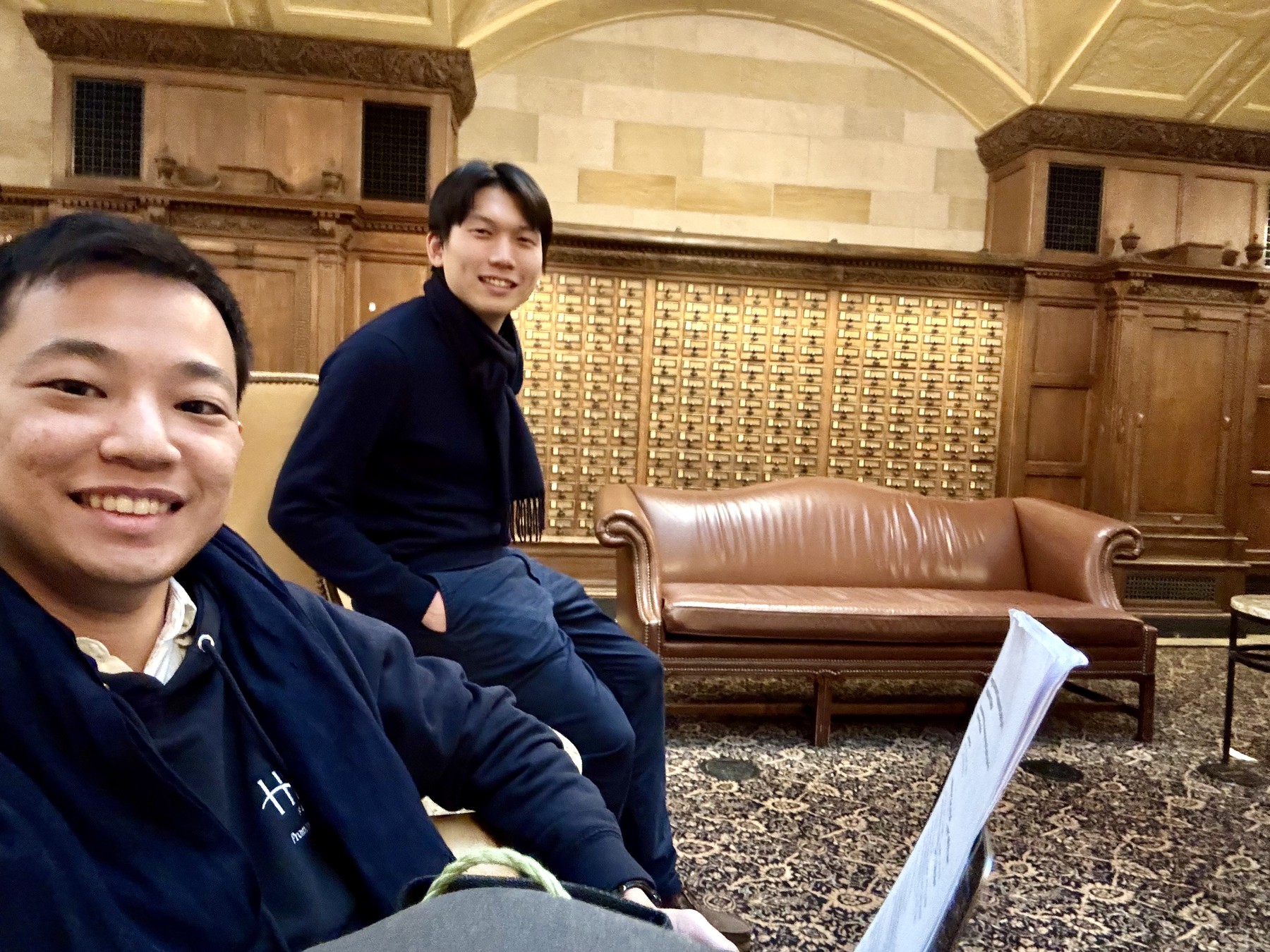
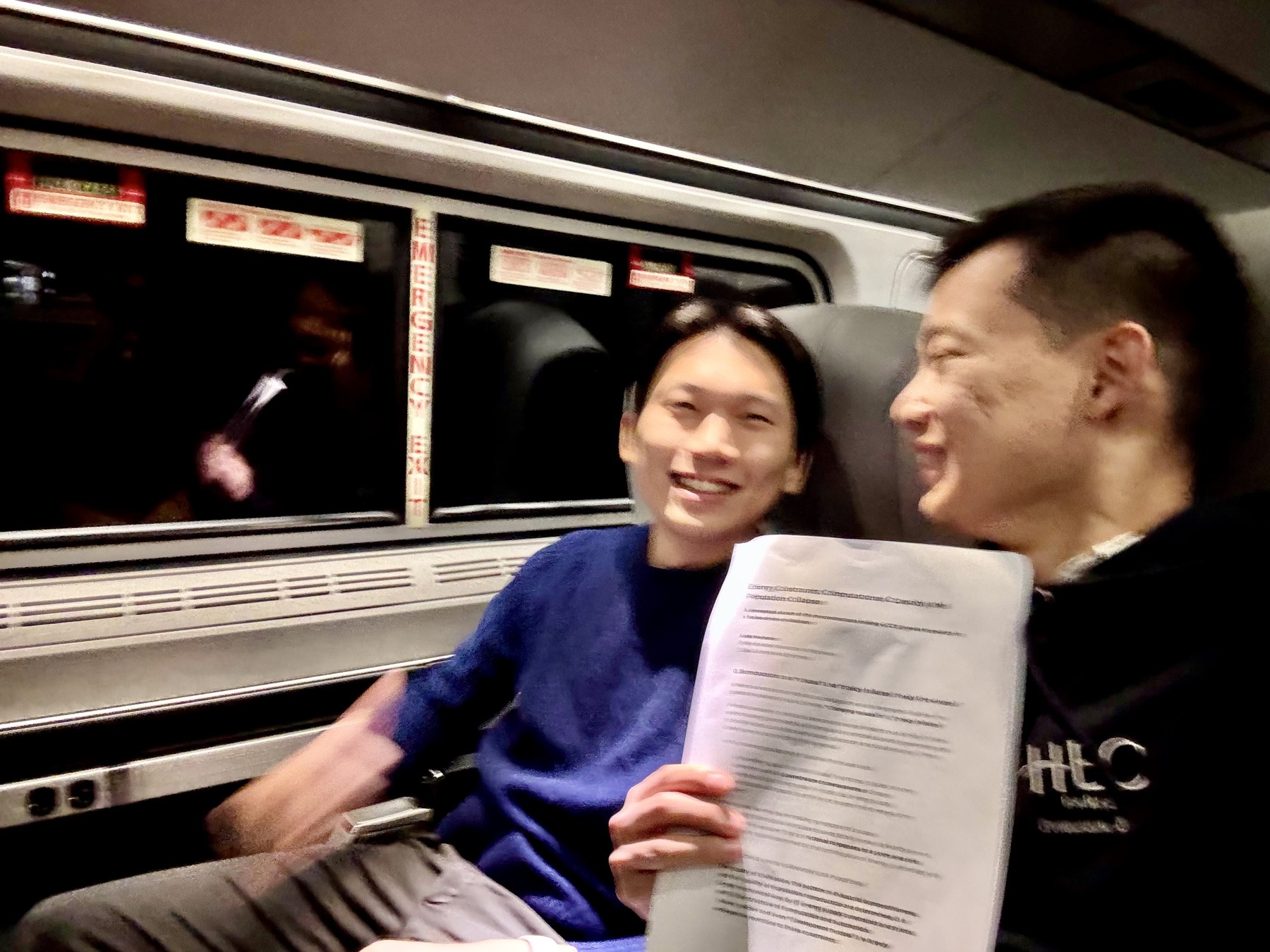
It all began with one phone call between the two of us in September 2025. From there, we talked about how to give it shape. I wrote the notes that Far Side of the Constraint grew from, and from November to December 2025, I visited Kei at Yale, in New Haven, Connecticut. We brainstormed and argued in his department building, and I revised in the library until I had finished an early draft. That draft became the prototype of Far Side of the Constraint. I owe him my deepest thanks. The photos in this essay show us in Connecticut.
2026: Putting it together into Far Side of the Constraint
In June 2026, I decided to leave my full-time job in the UAE, and my notice period began. In those months, I finished the 140-page thesis and its 20-page briefing.
The question I first asked at nineteen has become one argument: that stagnant economies, collapsing birth rates, and wealth that no longer reaches households may all come from a single constraint, our shrinking capacity to build at scale. The ten essays that follow lay out that argument one piece at a time, each built around a single figure.
Please think of this project as a grand collaboration that includes you, the reader, and let's work through it together. I would love to hear from you, too.
My email is arata.h.hoshino@gmail.com, and I am on LinkedIn at https://www.linkedin.com/in/arata-hoshino/.